A long train journey was broken with a detour via Tamworth to view the latest build progress. The boatman's cabin had received most attention. All the furniture is built and installed with the exception of the bench seat which was being worked on. This includes the bed'ole with fold out door forming the bed base, three large cupboards above plus a wide shallow draw below.
The very robust fold down table with the crumb draw below.
By the rear doors the storage shelves and slots each side plus of course the authentic ticket draw used in the past to store documentation for loads carried. Some thought will have to go into the placement of bowthruster, tunnel lamp and horn controls in this area although the panel is already made. A compact marine VHF unit also needs to be accommodated, but that will be on the opposite side of the doors.
A little extra work had taken place in the galley. The washing machine cupboard had been fleshed out with a large solid cutlery draw above. It really needs the L shaped worksurface adding to better see the layout. We discussed and agreed the placement of the small semi-circular folding breakfast table on the opposite side of the galley. I had intended that this would line up with the galley double doors, but it seems the worksurface is a little longer than planned with a lesser radius possible on the edge. This is a knock on effect of the thickness of wood used. Its easy to think in terms of house fittings, but of course a boat requires more solid construction and Steve doesn't seem to skimp in this area. In any case an offset of five inches placed the table with space for a couple of stools and the front edge in line with the opening doors to still allow al-fresco breakfasts.
Supply and fitting of an all black Shoreline 100 litre fridge was discussed, a little larger than planned and matching the black microwave/grill I've already purchased. This in turn to match the charcoal/brushed stainless theme of the galley as a whole.
It seems all the cupboard doors have been made. I saw a stack of various shapes and sizes in the galley. The solid wood relief is mated to a thick plywood backing.
Finally the two stainless tanks have been fitted. The water tank of 128 gallons situated under the well deck was already plumbed with filler and exit with valve. A little disappointed that this fell short of the 140 gallons promised, but won't shed any tears over it. Some small amount of water plumbing has been added in the galley as well. The large poop tank was fitted in the bathroom and when boxed in will provide a step down from the engine room with a further step down to the main bathroom floor. The loo will sit conveniently on top of tank.
I think next time I visit the woodwork will look much more complete and recognisable. Dotted around the boat were the frameworks for both front saloon cupboards and the one overhead cupboard. A second overhead cupboard was spotted destined for the bathroom I believe, plus the front of the engine room cupboard, all waiting to be fitted.
Work will now continue from back to front. After completion of the boatman's cabin the engine room cupboard will be built to house electrical switchgear. The bathroom will be next with quadrant shower already on order. Completion of woodwork expected in about six weeks.
Tuesday, 27 September 2011
Saturday, 3 September 2011
Steaming ahead
Returning from a family wedding on 2nd September, we routed via Tamworth to view the build progress. Arriving during the lunch break in a car loaded with everything including the kitchen sink, we had an excellent photo opportunity without tripping over workmen.
We had previously been told that the woodwork had started in the bedroom, but were pleased to see it almost complete including the requested slatted bed base, only requiring cupboard doors, a shelf between side cupboards and the porthole lining.
Wardrobe and dressing table with overhead cupboard which will include a downlighter. The shallow table will have a fold out section to accommodate a laptop.
Although we had recent phone discussions on the galley layout, we were again surprised to find the woodwork nearing completion. I guess I'm definitely paying Steve too promptly. The partial bulkhead from saloon can be seen in the foreground with overhead and under worksurface cupboards. To the rear is the fridge/freezer, oven and microwave stack. Still awaiting the worksurface of course. We were advised to reverse the planned orientation of the kitchen sink so the integral draining board would work given the boats slope down from bow to stern.
To the left of picture the space for a compact washing machine can be seen. It will be completely hidden behind a door, with gas hob recessed into the worksurface above. Between the two will be a cutlery draw. There is a small semi-circular fold-down breakfast table to be added on the opposite side of the galley in front of the opening doors.
Compact saloon awaiting cupboards and main fold down table. A stove will be fitted just the other side of the galley bulkhead on the right. Corner cupboards will be added each side of the front doors.
Bare boatman's cabin now with floor. Furniture is being completed and will be fitted soon. We also found the non-slip engine room flooring had been completed with large access cut-outs to the under floor equipment on both sides. Just a tall corner cupboard to be fitted there to accommodate the DC and AC electrical switchgear.
In all excellent progress considering the two week break Steve and his staff have mid summer. From now on I will be visiting regularly every three weeks or so to monitor the fit and discuss the inevitable issues that arise.
We had previously been told that the woodwork had started in the bedroom, but were pleased to see it almost complete including the requested slatted bed base, only requiring cupboard doors, a shelf between side cupboards and the porthole lining.
Wardrobe and dressing table with overhead cupboard which will include a downlighter. The shallow table will have a fold out section to accommodate a laptop.
Although we had recent phone discussions on the galley layout, we were again surprised to find the woodwork nearing completion. I guess I'm definitely paying Steve too promptly. The partial bulkhead from saloon can be seen in the foreground with overhead and under worksurface cupboards. To the rear is the fridge/freezer, oven and microwave stack. Still awaiting the worksurface of course. We were advised to reverse the planned orientation of the kitchen sink so the integral draining board would work given the boats slope down from bow to stern.
To the left of picture the space for a compact washing machine can be seen. It will be completely hidden behind a door, with gas hob recessed into the worksurface above. Between the two will be a cutlery draw. There is a small semi-circular fold-down breakfast table to be added on the opposite side of the galley in front of the opening doors.
Compact saloon awaiting cupboards and main fold down table. A stove will be fitted just the other side of the galley bulkhead on the right. Corner cupboards will be added each side of the front doors.
Bare boatman's cabin now with floor. Furniture is being completed and will be fitted soon. We also found the non-slip engine room flooring had been completed with large access cut-outs to the under floor equipment on both sides. Just a tall corner cupboard to be fitted there to accommodate the DC and AC electrical switchgear.
In all excellent progress considering the two week break Steve and his staff have mid summer. From now on I will be visiting regularly every three weeks or so to monitor the fit and discuss the inevitable issues that arise.
Wednesday, 24 August 2011
Fast lane
When Steve starts building a boat he doesn't hang around. By early June, just four weeks after first steel was laid, it already looked like a boat complete with roof. Maybe I was paying him too promptly ;-) The small lug left on the base plate which you can see if you click on image, is to tow out the boat during launch. Its cut off before it enters the water.
On June 20th it was launched. You can see it had to be restrained such was its enthusiasm to be in the water. Next job was to fit windows, portholes, roof vents and generally make it rain proof. Pigeon box's, I have two, will be fitted later so the holes were just capped over.
At this stage it might be easier to refer to the boat by name. A short list was made, added to, changed etc. I used to be indecisive but now I'm not so sure springs to mind. I wanted something with a northern ring to it given my Yorkshire birthright. Naming it after one of my favourite beers also seemed appropriate. I designed my own take on an Old Thumper beer bottle label (see upper right). This will be reserved as a name and logo for the engine though. Val came up with Ecky Thump which seems to have stuck although with Lancastrian rather than Yorkshire origins.
Early in July I visited Steve at Tamworth to view Ecky Thump for the first time in the water. Another proud moment especially as the engine had now been installed, sitting in its rightful place on iroko timbers. Note integral full width fuel tank of about 90 gallons immediately behind engine. Fuel will be hand pumped from this to a gravity feed day tank to supply engine in the traditional fashion.
Hear it starting up
Steve's classic take on Josher bows. Note also hatch to gas bottle locker and custom mount for Francis searchlight. Side lockers in well deck can just be seen, one of which will house bowthruster batteries.
Ballasting, spray foam insulation and battening had already been completed. The 18mm ply flooring had also been fitted. It continued to surprise just how quickly this had all been completed and I found it hard to believe it wouldn't be complete before Steve's estimate of March next year. Of course this is just the start of the hard slog of fitting out a boat.
Steve's annual open weekend on the 23rd/24th of July provided another opportunity to view progress. Val and I came up on the train and stayed overnight in Tamworth. Old and new customers make this an annual event taking advantage of Steve's generous hospitality. Its a unique opportunity to view at least five boats under various stages of construction as well as seeing completed ones shown off by their proud owners.
As little time had passed since my previous visit, only a modest amount of further work had been completed. First fit electric cabling mainly for lighting had been installed and most of the oak bead and butt planking to cabin sides and roof had been fitted. Cheaper softwood had been used for engine room and BMC as they will eventually be scumbled in the traditional style. Hardwood frames to match the surrounding wood had been fitted around the three side doors.
On June 20th it was launched. You can see it had to be restrained such was its enthusiasm to be in the water. Next job was to fit windows, portholes, roof vents and generally make it rain proof. Pigeon box's, I have two, will be fitted later so the holes were just capped over.
At this stage it might be easier to refer to the boat by name. A short list was made, added to, changed etc. I used to be indecisive but now I'm not so sure springs to mind. I wanted something with a northern ring to it given my Yorkshire birthright. Naming it after one of my favourite beers also seemed appropriate. I designed my own take on an Old Thumper beer bottle label (see upper right). This will be reserved as a name and logo for the engine though. Val came up with Ecky Thump which seems to have stuck although with Lancastrian rather than Yorkshire origins.
Early in July I visited Steve at Tamworth to view Ecky Thump for the first time in the water. Another proud moment especially as the engine had now been installed, sitting in its rightful place on iroko timbers. Note integral full width fuel tank of about 90 gallons immediately behind engine. Fuel will be hand pumped from this to a gravity feed day tank to supply engine in the traditional fashion.
Hear it starting up
Steve's classic take on Josher bows. Note also hatch to gas bottle locker and custom mount for Francis searchlight. Side lockers in well deck can just be seen, one of which will house bowthruster batteries.
Ballasting, spray foam insulation and battening had already been completed. The 18mm ply flooring had also been fitted. It continued to surprise just how quickly this had all been completed and I found it hard to believe it wouldn't be complete before Steve's estimate of March next year. Of course this is just the start of the hard slog of fitting out a boat.
Steve's annual open weekend on the 23rd/24th of July provided another opportunity to view progress. Val and I came up on the train and stayed overnight in Tamworth. Old and new customers make this an annual event taking advantage of Steve's generous hospitality. Its a unique opportunity to view at least five boats under various stages of construction as well as seeing completed ones shown off by their proud owners.
As little time had passed since my previous visit, only a modest amount of further work had been completed. First fit electric cabling mainly for lighting had been installed and most of the oak bead and butt planking to cabin sides and roof had been fitted. Cheaper softwood had been used for engine room and BMC as they will eventually be scumbled in the traditional style. Hardwood frames to match the surrounding wood had been fitted around the three side doors.
Tuesday, 23 August 2011
Bells and Whistles
Whilst waiting for the boat build to start and engine rebuild to complete, I became actively involved in a couple of canal boat forums. This gave a dramatic boost to my knowledge of narrowboats, but it was whilst browsing a canal boat magazine that I saw featured a boat with an oversize searchlight mounted on the bows. Investigation revealed it was from the renown manufacturer Francis. It just looked so right albeit way more powerful than needed for a tunnel lamp. Nevertheless I just had to have one.
By chance I discovered a lady whose late husband rebuilt ex fire service ones, removing the chrome and highly polishing the brass body underneath. She had one left at a substantial price so I initially tried bidding on similar but unrestored ones on eBay. This proved fruitless so I bit the bullet and bought the 11 inch F type lamp from her when she agreed to throw in an original brass base.
Further investigations of antique brassware evolved into a secondary interest and other modest purchases followed including a three bell terret to be mounted on the engine room pigeon box. I could only get excited about items I could see fitting into my boat concept though. Some items just looked right others didn't. So far I have old kitchen scales, a twin burner oil lamp, miners safety lamp, copper kettle and the ubiquitous horse brasses to adorn the boatman's cabin.
Following visits to various narrowboat rallies I saw many boats toting vintage brass trumpeted horns. Back on eBay after much web surfing I began to get a feel for what was sort after. After failing on the bidding for several classic horns I took a gamble on a vintage Desmo one from the prolific manufacturer in Birmingham and finally won the bid. The chrome on the trumpet was worn in places to the extent that I could see the brass underneath. After at least twelve hours of hard labour which included rebuilding and re-painting, this was the result. I have since fabricated a mounting bracket.
At the Braunston historic boat festival I bought this huge old oil pressure gauge. The calibration was just right for the Lister and as soon as I saw it, pictured it sitting on the engine room bulkhead. This will be complemented by the brass tidal clock and copper anchor lamp I already owned plus an extremely cheap old brass grease gun, another eBay purchase. Another smaller brass oil pressure gauge will sit mounted on the roof behind the pigeon box in view of the steerer.
Clearly I'm going to get plenty of arm exercise in the future.
By chance I discovered a lady whose late husband rebuilt ex fire service ones, removing the chrome and highly polishing the brass body underneath. She had one left at a substantial price so I initially tried bidding on similar but unrestored ones on eBay. This proved fruitless so I bit the bullet and bought the 11 inch F type lamp from her when she agreed to throw in an original brass base.
Further investigations of antique brassware evolved into a secondary interest and other modest purchases followed including a three bell terret to be mounted on the engine room pigeon box. I could only get excited about items I could see fitting into my boat concept though. Some items just looked right others didn't. So far I have old kitchen scales, a twin burner oil lamp, miners safety lamp, copper kettle and the ubiquitous horse brasses to adorn the boatman's cabin.
Following visits to various narrowboat rallies I saw many boats toting vintage brass trumpeted horns. Back on eBay after much web surfing I began to get a feel for what was sort after. After failing on the bidding for several classic horns I took a gamble on a vintage Desmo one from the prolific manufacturer in Birmingham and finally won the bid. The chrome on the trumpet was worn in places to the extent that I could see the brass underneath. After at least twelve hours of hard labour which included rebuilding and re-painting, this was the result. I have since fabricated a mounting bracket.
At the Braunston historic boat festival I bought this huge old oil pressure gauge. The calibration was just right for the Lister and as soon as I saw it, pictured it sitting on the engine room bulkhead. This will be complemented by the brass tidal clock and copper anchor lamp I already owned plus an extremely cheap old brass grease gun, another eBay purchase. Another smaller brass oil pressure gauge will sit mounted on the roof behind the pigeon box in view of the steerer.
Clearly I'm going to get plenty of arm exercise in the future.
Monday, 22 August 2011
How it all started
Nine months ago I knew nothing of narrowboats other than their derivation from the long, thin working boats designed to carry loads in the past through the narrow canals and locks of the UK network. Sure I had spent a day on one belonging to a work colleague, but that was back in the 70's. No one could fail to be impressed by the brightly coloured traditionally patterned paintwork many wore though.
Having recently sold the yacht I lived on for eleven years, seven of which in the Caribbean, I did know I wanted to move on to cruise the UK canal network. Discussing the idea with my partner Val met with approval as it did with my whole family.
The appeal other than that of repatriating myself to the UK, was a less stressful lifestyle coupled with seeing town and country from the backside so to speak. I guess I've always had an interest in industrial archeology, so cruising the canals seemed an excellent opportunity to discover more.
Since returning to the UK I have immersed myself in narrowboat culture jumping onto a very steep learning curve. First decision made in what boat to purchase was dismissing wide beam ones. As I wanted to cruise as many canals as possible in England and Wales, a narrowboat would be needed to pass through the many narrow seven foot wide locks. Next came boat length. I was in the fortunate position to finance a purchase of any length, but initially assumed 57 feet would be the lock limited length to meet my go anywhere needs.
On this premise I started looking at secondhand ones. Vendors would explain the attributes of trad style boats with Josher bows etc., but to be honest such explanations went right over my head even when shown examples. Same with trad v semi-trad v cruiser sterns. However after viewing maybe half a dozen and watching a few videos it dawned on me in an almost pre-ordained way that what I wanted was a traditional style narrowboat with boatmans cabin (BMC), trad stern and a big twin cylinder vintage diesel chugging away in its own engine room. Even the Fellows, Morton & Clayton red/green/yellow paint scheme seen on many old working boats was the only one that looked right.
I already had the AC and DC electrical requirements planned out given my background and previous experience in boat ownership. It then became apparent that a new build might best suit me. Various builders were contacted but I had been impressed from the outset by Steve Hudson's offerings. What really appealed was that he seemed to specialise in exactly what I wanted whilst providing everything from raw steel to sign writing in-house. The fact that he was highly recommended by several folk in the know convinced me he was the man.
I drew up scale plans using CorelDraw on my laptop. Fitting in all the compartments as well as engine room and BMC proved that space was a little tight, but by allowing the length to creep up to 60 feet I was able to shoe-horn everything in. I was assured that most 57 foot locks would accommodate a 60 foot boat at a pinch, so accepted that what limitations this imposed would be minimal.
Around about the same time I discovered Marine Power Services, a father and son business based near the south coast. Their excellent website displayed a range of vintage diesels for complete rebuild at what first seemed alarming prices. Browsing through the on-line videos of their past rebuilds the choice seemed to be between a Lister JP2 or Gardner 2LW. It was the huge external flywheel, individual cylinder heads and the whine of the gear driven timing on JP's that won the day. I met Martyn at his base near Poole and shortly after put down a deposit on a sad looking but rare Lister JP2M marine unit built in 1936. This to be fully rebuilt with electric start conversion to complement the original overhead chain driven hand start, and mated to a modern hydraulic PRM gearbox. I could have had the original Blackstone box, but almost total lack of spares and the fact that the cones were prone to jamming after continued time in gear made me plum for the easier life.
I guess it would have been easy to say I just wanted a totally traditional build and dismiss anything modern, but for the same reason the trad approach just grew on me so did the need for something practical and user friendly to live on, hence the electric start conversion for the JP.
The best part of a day spent with Steve Hudson revealed that he could build what I wanted although I would accept as far as possible his well proven design features. At first a £500 build slot deposit was placed on a 60 foot trad sailaway with completed BMC, my rebuilt JP fitted and running plus a working bathroom. As plans developed however I realised it would make more sense to have him build the whole boat although I wanted to be actively involved in the main AC and DC electrics.
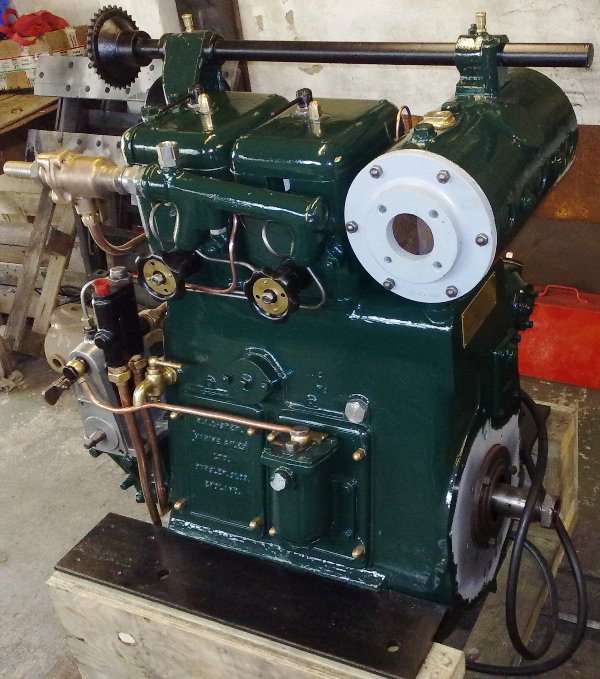
First run of completely rebuilt Lister JP2M idling at 300 rpm. Note life support connections for water cooling and oil from external tank as this marine engine has a dry sump. Also the compression changeover handwheels facilitating cold start on the first diesels Lister made. Oil pressure at correct 20 psi although still cool.
My build slot was initially booked to start early April but this eventually slipped and the first steel was laid down early May. Meanwhile the engine rebuild started at the beginning of the year, was progressing nicely. So it was on Monday 9th May I took the train to Steve Hudson's boatyard in Tamworth to meet him for the second time, with the rebuilt Lister seen for the first time when delivered to him the same day. In Steve's steelwork shed the chosen 15mm baseplate was being welded up, so with a feeling of euphoria I saw the intensive planning made in the preceding months finally turning into something tangible.
Having recently sold the yacht I lived on for eleven years, seven of which in the Caribbean, I did know I wanted to move on to cruise the UK canal network. Discussing the idea with my partner Val met with approval as it did with my whole family.
The appeal other than that of repatriating myself to the UK, was a less stressful lifestyle coupled with seeing town and country from the backside so to speak. I guess I've always had an interest in industrial archeology, so cruising the canals seemed an excellent opportunity to discover more.
Since returning to the UK I have immersed myself in narrowboat culture jumping onto a very steep learning curve. First decision made in what boat to purchase was dismissing wide beam ones. As I wanted to cruise as many canals as possible in England and Wales, a narrowboat would be needed to pass through the many narrow seven foot wide locks. Next came boat length. I was in the fortunate position to finance a purchase of any length, but initially assumed 57 feet would be the lock limited length to meet my go anywhere needs.
On this premise I started looking at secondhand ones. Vendors would explain the attributes of trad style boats with Josher bows etc., but to be honest such explanations went right over my head even when shown examples. Same with trad v semi-trad v cruiser sterns. However after viewing maybe half a dozen and watching a few videos it dawned on me in an almost pre-ordained way that what I wanted was a traditional style narrowboat with boatmans cabin (BMC), trad stern and a big twin cylinder vintage diesel chugging away in its own engine room. Even the Fellows, Morton & Clayton red/green/yellow paint scheme seen on many old working boats was the only one that looked right.
I already had the AC and DC electrical requirements planned out given my background and previous experience in boat ownership. It then became apparent that a new build might best suit me. Various builders were contacted but I had been impressed from the outset by Steve Hudson's offerings. What really appealed was that he seemed to specialise in exactly what I wanted whilst providing everything from raw steel to sign writing in-house. The fact that he was highly recommended by several folk in the know convinced me he was the man.
I drew up scale plans using CorelDraw on my laptop. Fitting in all the compartments as well as engine room and BMC proved that space was a little tight, but by allowing the length to creep up to 60 feet I was able to shoe-horn everything in. I was assured that most 57 foot locks would accommodate a 60 foot boat at a pinch, so accepted that what limitations this imposed would be minimal.
Around about the same time I discovered Marine Power Services, a father and son business based near the south coast. Their excellent website displayed a range of vintage diesels for complete rebuild at what first seemed alarming prices. Browsing through the on-line videos of their past rebuilds the choice seemed to be between a Lister JP2 or Gardner 2LW. It was the huge external flywheel, individual cylinder heads and the whine of the gear driven timing on JP's that won the day. I met Martyn at his base near Poole and shortly after put down a deposit on a sad looking but rare Lister JP2M marine unit built in 1936. This to be fully rebuilt with electric start conversion to complement the original overhead chain driven hand start, and mated to a modern hydraulic PRM gearbox. I could have had the original Blackstone box, but almost total lack of spares and the fact that the cones were prone to jamming after continued time in gear made me plum for the easier life.
I guess it would have been easy to say I just wanted a totally traditional build and dismiss anything modern, but for the same reason the trad approach just grew on me so did the need for something practical and user friendly to live on, hence the electric start conversion for the JP.
The best part of a day spent with Steve Hudson revealed that he could build what I wanted although I would accept as far as possible his well proven design features. At first a £500 build slot deposit was placed on a 60 foot trad sailaway with completed BMC, my rebuilt JP fitted and running plus a working bathroom. As plans developed however I realised it would make more sense to have him build the whole boat although I wanted to be actively involved in the main AC and DC electrics.
First run of completely rebuilt Lister JP2M idling at 300 rpm. Note life support connections for water cooling and oil from external tank as this marine engine has a dry sump. Also the compression changeover handwheels facilitating cold start on the first diesels Lister made. Oil pressure at correct 20 psi although still cool.
My build slot was initially booked to start early April but this eventually slipped and the first steel was laid down early May. Meanwhile the engine rebuild started at the beginning of the year, was progressing nicely. So it was on Monday 9th May I took the train to Steve Hudson's boatyard in Tamworth to meet him for the second time, with the rebuilt Lister seen for the first time when delivered to him the same day. In Steve's steelwork shed the chosen 15mm baseplate was being welded up, so with a feeling of euphoria I saw the intensive planning made in the preceding months finally turning into something tangible.
Subscribe to:
Posts (Atom)